
Why Deep Conditioning for Frizzy Hair Actually Works (And How to Do It Right)
Deep conditioning for frizzy hair isn’t just another beauty trend—it’s the science-backed solution that repairs your hair’s structure from the inside out, locking in moisture and smoothing those rebellious strands for good.
Stop Frizz Before It Starts: The Weekly Routine That Actually Works
Look, we’ve seen every type of frizzy hair walk through my salon doors. The kind that puffs up the second humidity hits. The kind that looks great until you step outside. The kind that just… does its own thing no matter what you try.
Here’s what we tell our Salon Baci clients: deep conditioning isn’t a luxury treatment you do once in a blue moon. It’s your hair’s actual hydration system. Think of it like this: your skin needs moisturizer, right? Your hair needs deep conditioning. Same concept, different texture.
I’m Emily at Salon Baci, and we’ve spent time figuring out what actually works for frizzy hair versus what just sounds good on a bottle. Let me walk you through why deep conditioning is the game-changer you’ve been looking for.
 Key Takeaways
> Deep conditioning repairs damaged hair cuticles, which is the root cause of most frizz
> Moisture retention is everything, hydrated hair doesn’t puff up in humidity
> Weekly treatments prevent breakage and split ends that make frizz worse
> The right deep conditioner for your hair type makes all the difference
> Results happen when you use proper application techniques
What’s Really Causing Your Frizzy Hair (And Why It Matters)
Let me break down what’s actually happening with frizzy hair. Your hair has this outer layer called the cuticle—imagine it like roof shingles. When those “shingles” are smooth and flat, light reflects off them and your hair looks shiny and sleek.
But when they’re raised or damaged? Moisture from the air sneaks in, your hair swells up, and boom; you’ve got frizz.
Your hair structure is basically three layers. The cuticle is the outer protective layer, and when it’s compromised—from heat styling, chemical treatments, or just living your life—it can’t hold moisture properly.
Dry hair is desperate for hydration. So when humidity happens, your hair tries to grab moisture from the air.
We see this often. Someone comes in with beautiful hair that just won’t cooperate. We look at their routine, and usually, they’re shampooing daily, skipping conditioner, or using products with alcohol that dry everything out.
Common Frizz Triggers
Here’s what’s making your frizz worse
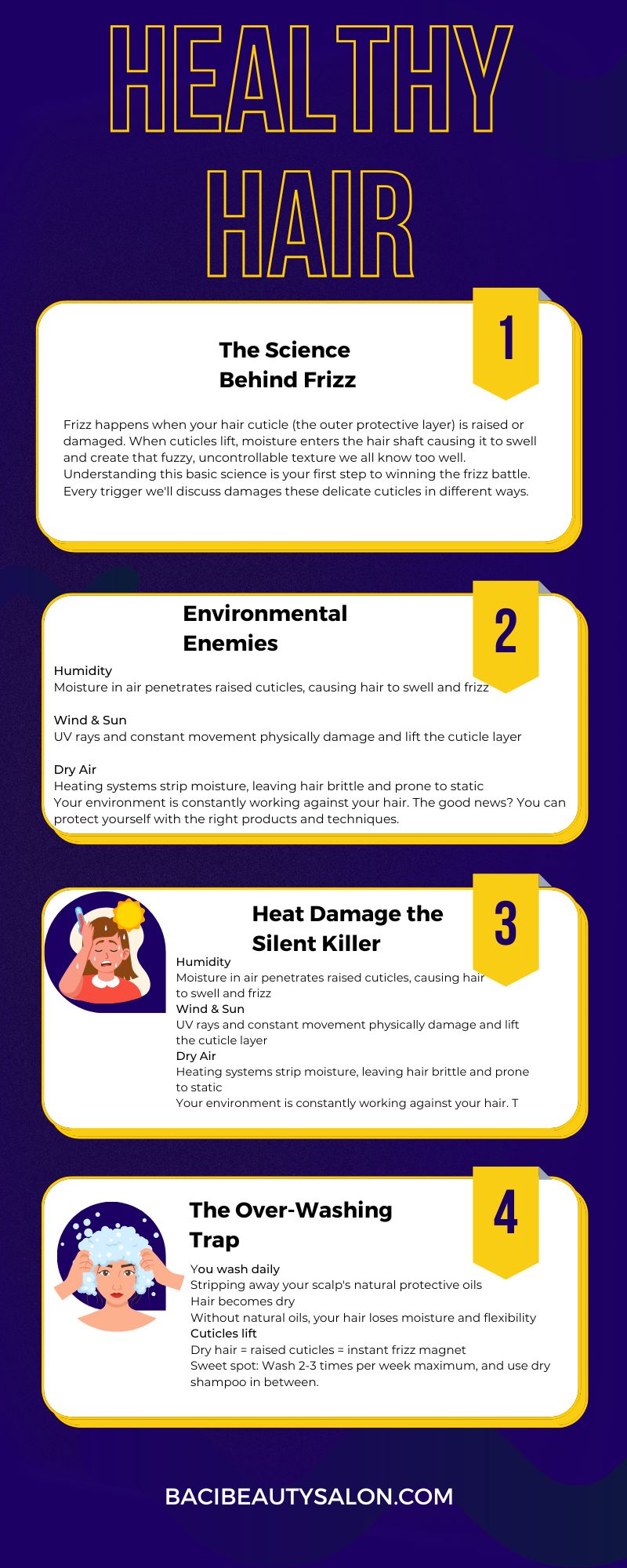
Environmental factors: Humidity, wind, sun exposure, and dry air from heating systems all damage your hair cuticle.
Heat damage: Flat irons, curling wands, blow dryers—they all raise the hair cuticle when used without protection.
Chemical processing: Color treatments, relaxers, and perms alter your hair structure. You need to compensate with serious conditioning.
Over-washing: Washing too often strips your natural oils, leaving your hair dry and frizz-prone.
Wrong products: Sulfates, alcohol-heavy styling products, and heavy silicones that build up all contribute to the problem.
The texture of your hair matters too. Curly and coily hair types are naturally more prone to frizz because the curl pattern makes it harder for your scalp’s natural oils to travel down the hair shaf
How Deep Conditioning Treatment for Frizzy Hair Actually Works
Okay, here’s where it gets interesting. I reached out to someone way smarter than me about hair science to explain this properly.
Maria Fernanda Reis Gavazzoni Dias, International Journal of Trichology, breaks it down like this:
 “Conditioners are used to decrease friction, detangle the hair, minimize frizz and improve combability. Conditioners act by neutralizing the electrical negative charge of the hair fiber by adding positive charges and by lubricating the cuticle that reduces fiber hydrophilicity… The ideal conditioner is capable of restoring the hydrophobicity of the fiber and neutralizing static electricity. Depending on the capacity of entering the fiber, the conditioner may reach the cuticle surface or the inner part of the cortex… Functions of conditioners are: improve combability, mimic the hair natural lipid outer layer, restore hydrophobicity, seal the cuticle, avoid or minimize frizz and friction, and enhance shine, smoothness and manageability.” [1]
See what she’s saying? It’s basically like giving your hair a complete repair treatment and a moisture lock at the same time. That’s why I always recommend weekly deep conditioning sessions; you’re literally rebuilding your hair’s ability to stay smooth.
Regular conditioner is like a quick drink of water. Deep conditioning is like soaking in a hydrating bath for twenty minutes. Regular conditioner coats the outside of your hair and rinses away in minutes.
Deep conditioners have smaller molecules that actually get inside your hair shaft with higher concentrations of moisturizing oils, reconstructive proteins, and nourishing ingredients.
The Real Benefits
Let me tell you what actually happens when you start deep conditioning regularly:
Moisture that stays:
Deep conditioning improves your hair’s ability to hold onto moisture. Your hair becomes less porous, so it’s not constantly trying to grab water from the air. I have clients in Florida who’ve gotten their frizz under control with consistent deep conditioning.
Stronger, more flexible hair:
Healthy hair should be elastic. Deep conditioning strengthens the hair cuticle and improves elasticity, which means less breakage when you brush, fewer split ends, and better hold for styles.
Natural shine:
Frizzy hair usually looks dull because raised cuticles scatter light. When deep conditioning smooths those cuticles down, light reflects properly and your hair looks naturally shiny.
Easier styling:
This is what my clients care about most. Deep conditioned hair detangles faster, holds styles better, needs less heat styling, and cooperates with products.
How to Choose the Right Deep Conditioner for Your Hair
Not all deep conditioners are created equal. Here’s how I help clients figure out what they need.
 Know Your Hair Type
Fine hair: You need lightweight formulas that won’t weigh you down. Avoid anything too heavy with butter or thick oils as the first ingredients.
Thick or coarse hair: You can handle richer formulas. Shea butter, coconut oil, and heavier conditioners work great.
Curly or coily hair: Your hair type naturally needs more moisture. Look for deep conditioners specifically formulated for curls with great slip for detangling.
Color-treated hair: You need deep conditioners that are safe for color with UV protection. Your hair is more porous after coloring.
Damaged hair: Protein treatments mixed with moisture. Your hair needs reconstruction, not just hydration.
Ingredients That Actually Work
For moisture: Hyaluronic acid, glycerin, aloe vera, honey, coconut oil, argan oil, avocado oil
For protein repair: Hydrolyzed keratin, wheat protein, silk protein, amino acids
For smoothing: Shea butter, cocoa butter, dimethicone
Avoid: Sulfates (SLS, SLES), drying alcohols (denatured alcohol, SD alcohol)
Quick Selection Guide
| Hair Concern | Look For These Ingredients | Product Type |
| Extreme dryness | Shea butter, coconut oil, argan oil | Moisture mask |
| Damage/breakage | Hydrolyzed keratin, proteins, amino acids | Protein treatment |
| Frizz control | Dimethicone, argan oil, anti-humidity polymers | Smoothing mask |
| Limp, fine hair | Lightweight oils, panthenol, volumizing agents | Volumizing treatment |
| Curly hair | Coconut oil, shea butter, slip agents | Curly hair mask |
How to Use Deep Conditioning Curly Hair Mask (Or Any Hair Type)
This is where most people mess up. They buy a great product and then don’t use it right.
The Step-by-Step Process
Start with clean, damp hair. Shampoo first, squeeze out excess water. Your hair should be wet but not dripping.
Section your hair. This is key. Divide your hair into 4-6 sections depending on thickness. Use clips to keep them separate. This ensures every strand gets product.
Apply generously. Don’t be stingy. Start at the ends (the oldest, driest part) and work up toward your roots. If you have oily roots, stop a few inches away from your scalp.
Comb it through. Use a wide-tooth comb or your fingers to distribute the product evenly.
Add heat. Heat opens the hair cuticle and helps the product penetrate. You can wrap your hair in a warm damp towel, use a shower cap and sit under a hooded dryer, or just wear a shower cap and let your body heat do the work.
Wait at least 20 minutes. Minimum. For seriously damaged hair, leave it on for 30-45 minutes. This is your Netflix time, your bath time, your self-care routine.
Rinse thoroughly with cool water. The cool water helps seal the cuticle back down. Make sure you rinse completely—leftover product can make your hair look greasy.
Here is an authoritative quote from Wella Professionals, a leading professional haircare brand, that outlines the deep conditioning process without referencing a specific household product. This quote describes exactly how to use a deep conditioning hair mask for any hair type, including curly hair:
“Apply the mask to the mid-lengths and ends of your hair, allow it to absorb for five minutes, and then rinse it out thoroughly. You’ll feel the difference as soon as you start to style your hair… Work it section by section and then, after rinsing, make sure your drying technique is gentle on texture. What you need is a microfibre towel or a soft cotton t-shirt to blot – not rub – water out, so hair is prepped for styling. This mask is a weekly must-have to keep curly hair soft and springy from wash to wash, so remain consistent.” [2]
Pro Tips
Don’t skip the heat. Room temperature is fine, but heat really amps up the results.
Focus on your ends. The ends of your hair are the oldest and most damaged.
Alternate protein and moisture. If you do protein treatments, follow up with a moisture-based deep conditioner the next week. Your hair needs both.
Pay attention to how your hair feels. If it starts feeling mushy, you’re overdoing the moisture. If it feels brittle, you need more moisture and less protein.
Common Deep Conditioning Mistakes (And How to Fix Them)
Using too much or too little: Use about a tablespoon for short hair, two for medium length, three for long hair.
Applying to dirty hair: Always shampoo first. Use a clarifying shampoo once a month.
Skipping sectioning: Take the extra two minutes to section your hair. Four sections minimum.
Not leaving it on long enough: Twenty minutes minimum. Set a timer.
Rinsing with hot water: Rinse with cool or lukewarm water to seal the cuticle.
Using the wrong type: Match your product to your actual hair needs, not just what’s on sale.
Beyond Deep Conditioning: Other Frizz-Fighting Strategies
Deep conditioning for frizzy hair is your foundation, but here are other things that’ll help:
Microfiber towels or t-shirt drying: Regular towels rough up your cuticle. Switch to microfiber or an old cotton t-shirt. Just scrunch, don’t rub.
Heat protectant always: If you’re using heat tools, you need heat protectant. No exceptions.
Silk or satin pillowcases: Cotton creates friction while you sleep. Silk lets your hair glide smoothly.
Regular trims: Split ends make frizz worse. Get trims every 6-8 weeks
Frequently Asked Questions for Why Deep Conditioning Tackles Frizzy Hair Issues
 Here are several FAQ’s we hear about. We provide the answers using a Tab system so you can pick and choose which questions are important to you. Just Click Your Questions Below.
- How long does it take to see results from deep conditioning?
- Can you deep condition too much?
- Should I deep condition before or after coloring my hair?
- Will deep conditioning help with heat damage?
- How do I know if I need protein or moisture?
You’ll notice softer, smoother hair after your first treatment. But for real frizz control? Give it 3-4 weeks of consistent weekly treatments. We tell clients to commit to a month before deciding if something’s working.
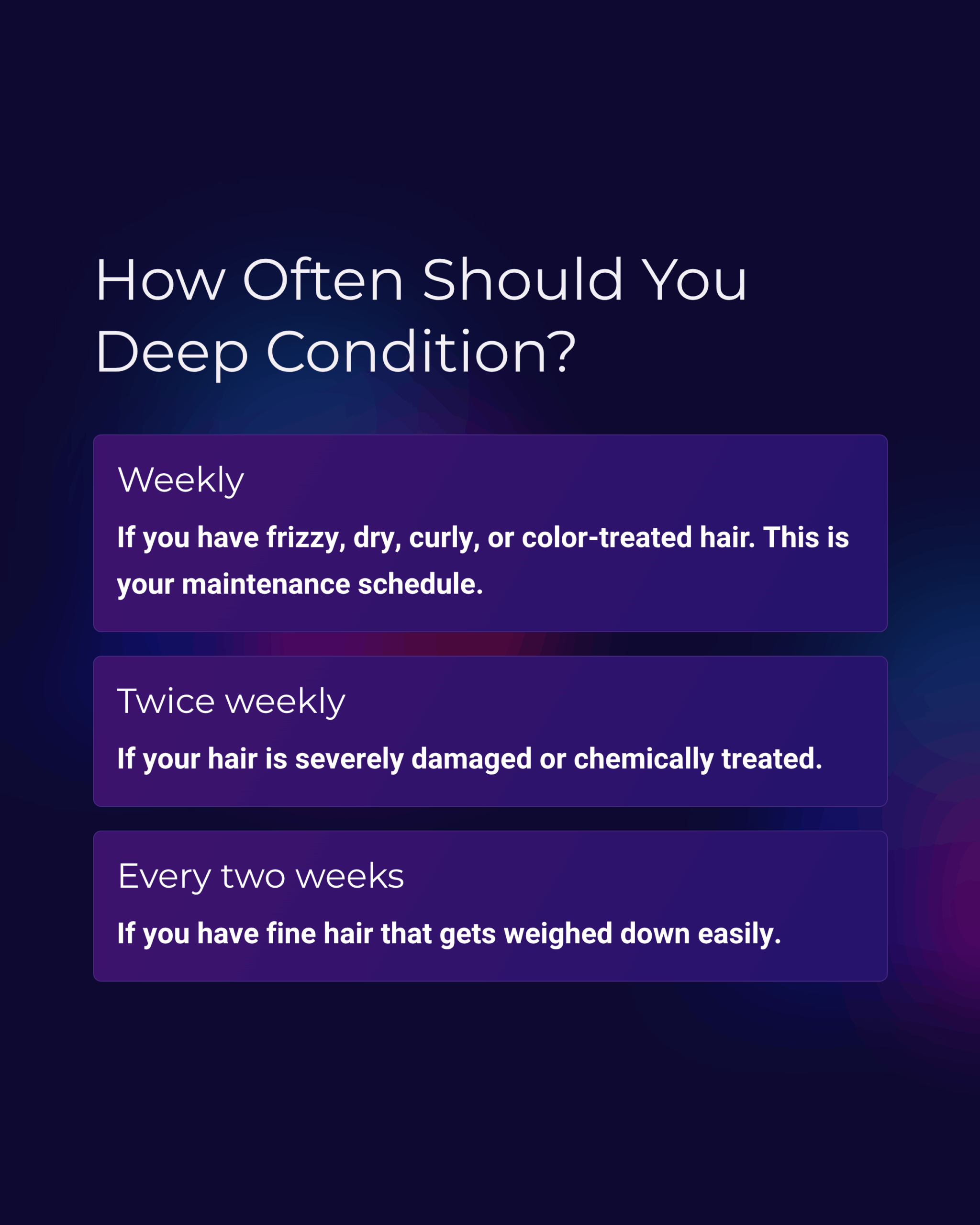
Yes, actually. Too much moisture can make your hair feel mushy or cause breakage. This is called hygral fatigue. Stick to once or twice weekly max.
Before coloring, do a treatment about a week out, not the same day. After coloring, wait 48-72 hours, then start your deep conditioning routine.
Deep conditioning can improve the appearance of heat-damaged hair and prevent further damage, but it can’t reverse severe damage. Prevention is way easier than repair.
If your hair feels mushy or stretchy when wet, you need protein.
If it feels dry, brittle, or breaks easily, you need moisture. Most frizzy hair needs moisture first.
Your Frizz-Free Hair Journey Starts Here
Look, I get it. Hair care can feel overwhelming. But deep conditioning for frizzy hair isn’t complicated—it’s just about consistency and using the right products for your hair type.
Start with once a week. Pick a day that works for you and make it your routine. Set a timer, actually leave it on long enough, and rinse with cool water. Do this for a month and I guarantee you’ll see a difference.
Your hair is dealing with damage from heat, environment, and just daily life. Deep conditioning gives it the moisture and repair it needs to stay smooth, manageable, and healthy.
Want to figure out which deep conditioning treatment is right for your specific hair situation? In the greater Cincinnati area, come see us at Salon Baci on Fountain Square, downtown. We’ll look at your hair together, talk about your routine, and we’ll help you create a plan that actually fits your life.
Your hair doesn’t have to be a daily battle. Let’s fix that.
RECOMMENDED RESOURCES:
You will find valuable information, tips, and help in our Salon Baci Learning Center. To access more in-depth ideas, go to our Hair Treatment Guide. Also, check out:

Authors: Guido & Emily Salzano
Salon Baci Learning Center: It is important to provide information and insights for those considering various salon services. For all your personalized salon services and treatments for your specific beauty needs, we recommend a professional consultation. An experienced stylists can assess your needs and create a tailored treatment plan. For those in the greater Cincinnati area we invite you to schedule an appointment at Salon Baci to discuss your unique hair and beauty needs.

For those of you in the greater Cincinnati area Salon Baci is located downtown in the famous Fountain Square District. Call us at 513 979-3203 or visit us at: 23 E. 6th St., Cincinnati, Ohio 45202
REFERENCES
[1]Maria Fernanda Reis Gavazzoni Dias. “Hair Cosmetics: An Overview.” International Journal of Trichology. 2015 Jan-Mar;7(1):2–15. doi:10.4103/0974-7753.153450
[2] Wella Professionals. “Deep Conditioning 101: Find Your Perfect Hair Treatment.” Wella Blog. July 23, 2024
Image Sources:
- Header Hairstyle images; Frizzy Hair : by Sohan Rahat from Pexels, Font: by geralt from pixabay
- Frizzy Hair: by R_Koopmans from Getty Images Signature
Graphics: Created in Canva.com. napkin.app, and Gamma.app
Article Content Development and AI: Refer to Terms & Conditions Page
Copyright 2025 | Salon Baci Cincinnati | All Rights Reserved