
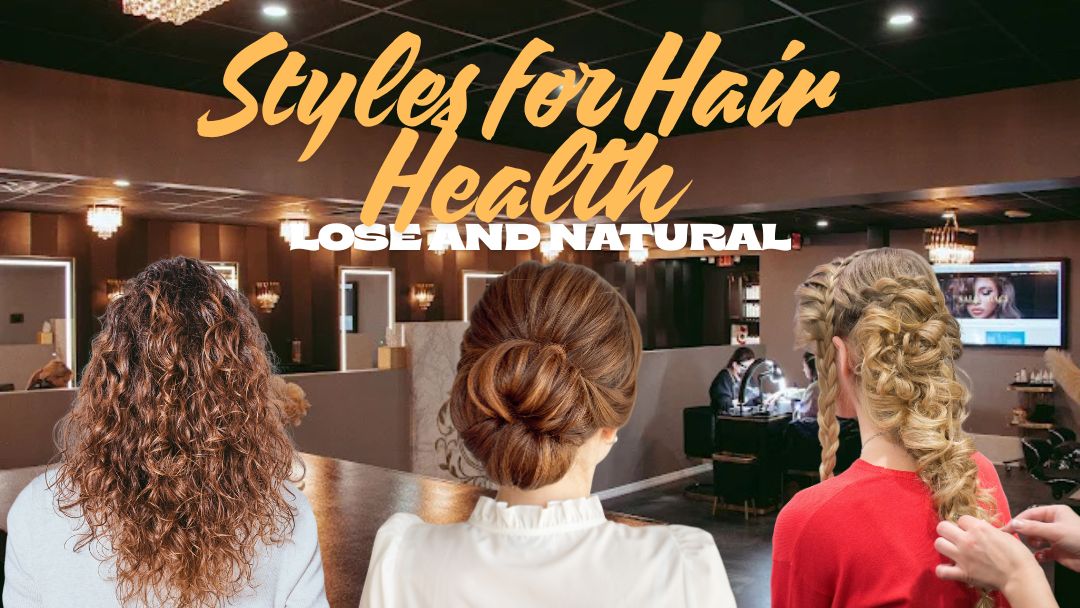
After 30 years behind the chair, I’ve learned that choosing healthy hair styles that boost hair health isn’t just about looking good today; it’s about protecting your hair so it stays strong, grows better, and looks great for years to come.
Stop Hair Damage Before It Starts: The Smart Style Selection System That Actually Works
Listen, I’ve been cutting hair as a master barber for three decades. In addition, with our recently opened Salon Baci we have added professional and experienced stylists. In both cases, barbershop and salon, there are a number of times someone sits in our chairs with damaged, broken hair, asking us to fix it.
Here’s what we tell them: the best time to fix damaged hair was six months ago. The second-best time is right now.
 Key Takeaways
> Healthy hair styles minimize daily damage by reducing tension, heat exposure, and excessive manipulation that weakens hair over time
> Protective styling techniques shield your hair from environmental stressors while promoting length retention and scalp health
> Low-manipulation hairstyles reduce breakage and split ends while giving your hair the rest it needs to repair and strengthen
> Understanding your hair’s unique needs helps you select styles that enhance your natural texture rather than fighting against it
> The right combination of style choice and proper hair care routine creates a foundation for stronger, more resilient hair growth
Hair Style versus Hair Health
This is what we do every single day. Our professional staff helps people understand that the styles they choose matter just as much as the products they use or the cuts they get. This is fundamental to selecting styles that boost hair health.
This is especially true in the salon environment.
I get it.
You want to look good. But you also want hair that’s healthy enough to style the way you want next month, next year, five years from now.
The Real Truth About Healthy Hair Styles (What 30 Years Taught Me)
You know what most people get wrong? They think healthy hair is all about products. We see this a lot with salon clients. They spend hundreds on treatments and serums, then turn around and style their hair in ways that undo all that good work. We see it every day.
Healthy hairstyles are about making smart choices that protect your hair while you’re living your life.
It’s not complicated, but it does require you to think differently about how you approach your hair.
What Makes a Hair Style “Healthy”?
Here’s the thing. A healthy hairstyle is one that doesn’t constantly stress your hair. Think about it like this: your hair is always dealing with something. The weather, pollution, rubbing against your collar, and getting tangled when you sleep.
That’s normal wear and tear.
But when you add styles that pull tight, require tons of heat, or need you to manipulate your hair constantly, you’re adding stress on top of stress.
After three decades of doing this work and with feedback from our salon stylists, we can spot damaged hair the moment someone walks through my door.
- The breakage around the hairline.
- The thinning at the temples.
- The split ends that keep coming back, no matter how often you trim.
These aren’t random. They’re usually the result of years of styling choices that worked against the hair instead of with it.
A healthy hairstyle protects your hair from unnecessary tension. It minimizes how much you have to touch and manipulate your hair throughout the day.
It reduces your reliance on heat styling tools that dry out and damage your hair shaft. And here’s the important part: it works with your natural hair texture instead of fighting it.
The Science Behind Hair Health (Made Simple)
I’m not a scientist, obviously. That said, we spend time staying current and understanding the “science behind hair health.”We’ve learned plenty about hair structure over the years. Your hair grows from follicles in your scalp.
Once it comes out of your scalp, it’s technically dead tissue. That means it can’t heal itself the way your skin can. Every bit of damage you do to your hair stays there until you cut it off.
This is why prevention matters so much. You can’t repair truly damaged hair. You can make it look better with the right products and treatments, but that damage is permanent.
The only real solution is to cut off the damaged parts and grow new, healthy hair to replace them.
L’Oréal Paris Beauty Magazine Editors explain hair structure in an article, “What Is Hair Made Of and How to Keep It Healthy,” in a way that makes sense:
“The hair shaft refers to the visible strands that exist outside of your skin. The shaft is composed of two (or sometimes three) layers: Cuticle layer — The cuticle is the outermost layer of your hair. It consists of dead, overlapping keratin fibers, as well as natural lipids that help protect your strands against external stressors, such as chemicals and heat. Cortex layer — The cortex makes up the bulk of your hair. This thick inner layer plays an important role in determining how your hair looks and feels. The cortex is composed primarily of keratin linked together by hair bonds. These bonds play a crucial role in maintaining your hair’s smoothness, strength, and healthy appearance. Medulla layer — Those with thick hair may also have a medulla layer. If present, it’s the innermost layer of the hair and acts as a “core” of sorts[1]
See what they’re getting at? Your hair’s outer layer is like armor. When you damage that armor with bad styling choices, everything underneath becomes vulnerable.
That’s why choosing protective styles that boost hair health isn’t just about vanity. It’s about preserving the structure of your hair.
You need to choose styles that don’t require constant manipulation and high heat.
The Protective Styling Philosophy I Teach Every Client
Here’s my philosophy, developed over 30 years: your hair should spend most of its time in low-stress situations. Save the high-manipulation, high-heat styles for special occasions. Make your everyday styles simple, gentle, and protective.
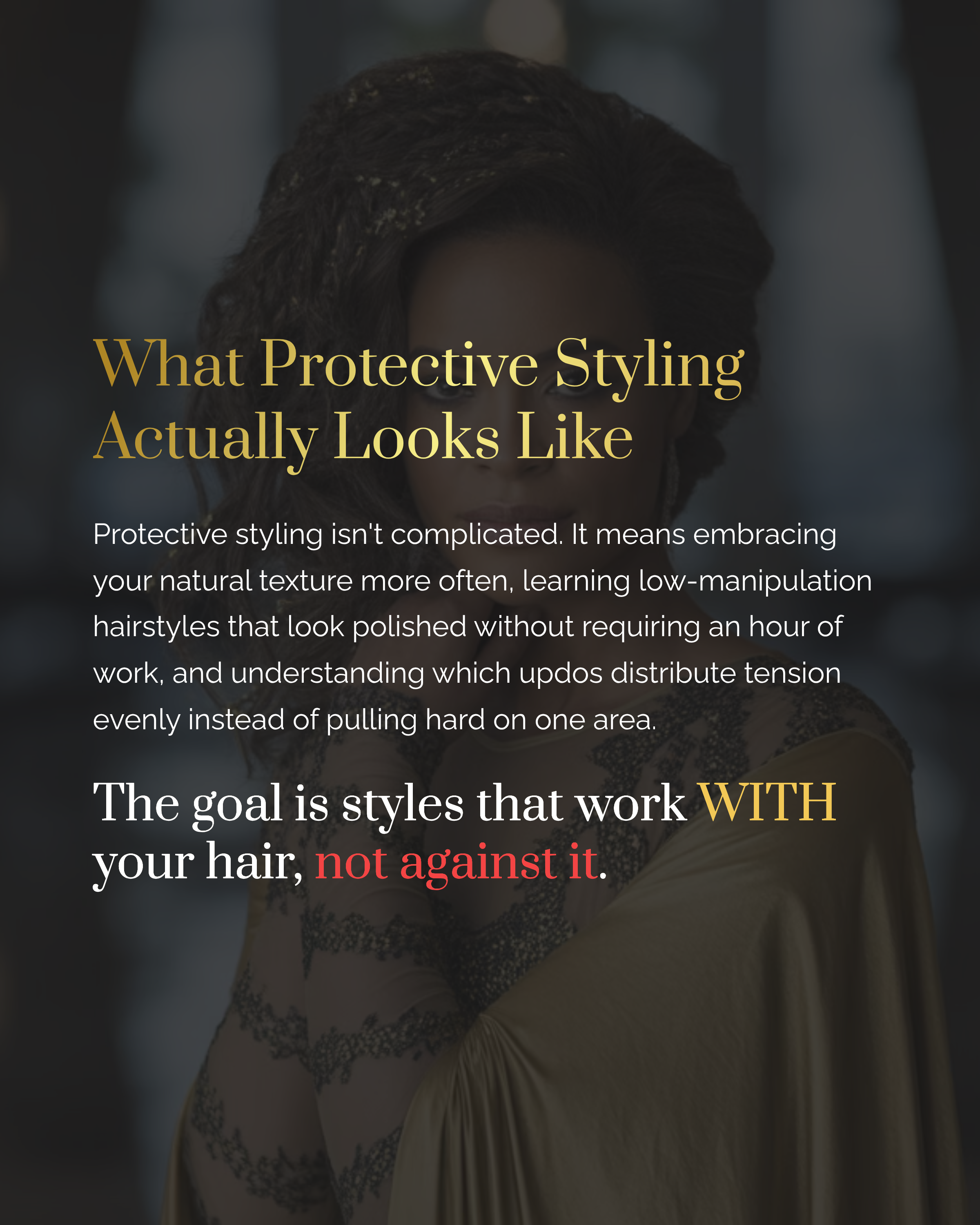
What does that look like in practice? It means embracing your natural texture more often. It means learning low-manipulation hairstyles that look polished without requiring an hour of work. It means understanding which updos distribute tension evenly instead of pulling hard on one area.
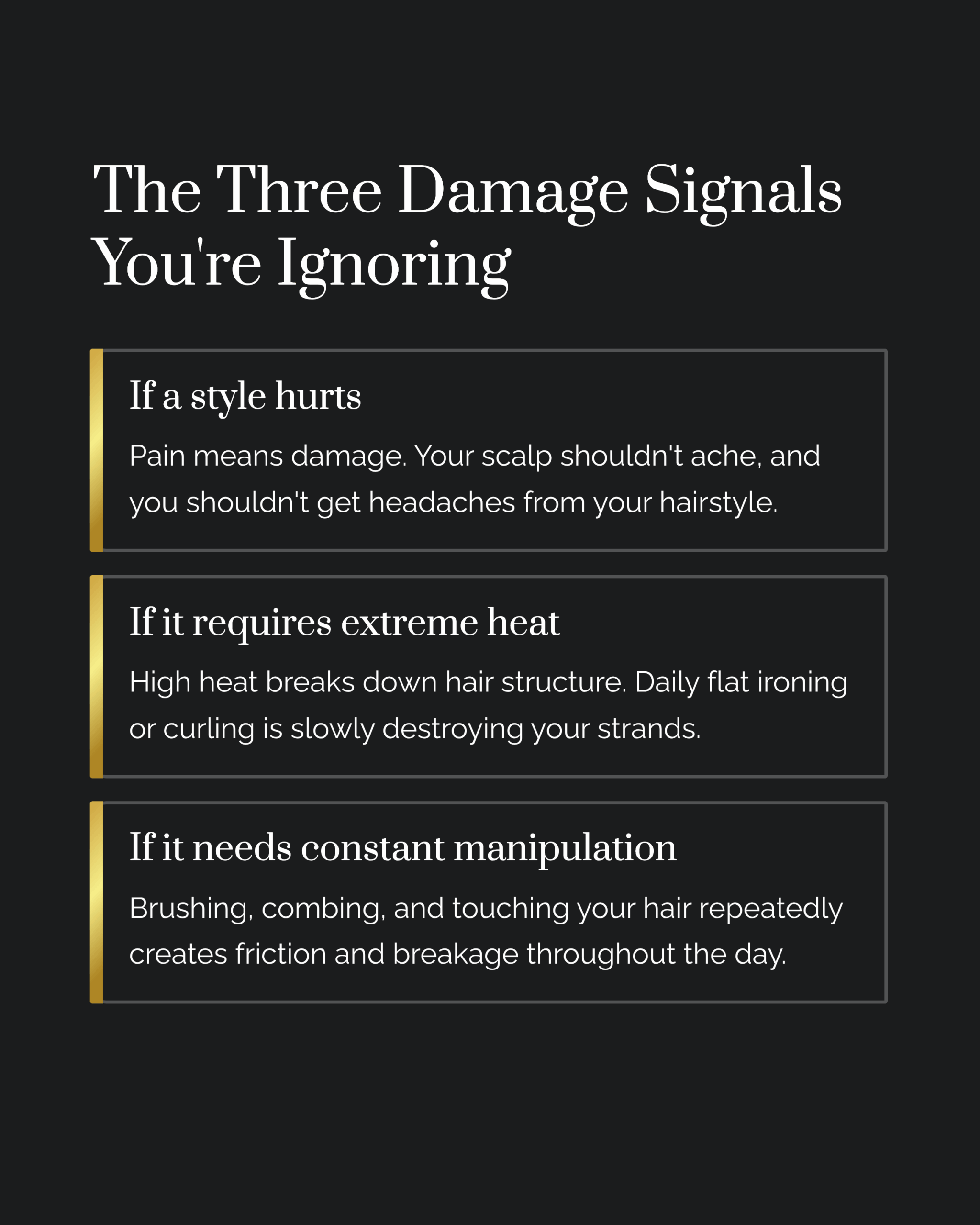
At Salon Baci, we strive to teach every client this: if a style hurts, it’s doing damage. If a style requires extreme heat, it’s doing damage. If a style needs you to brush, comb, and manipulate your hair constantly, it’s doing damage. The right style should feel comfortable, look good, and let your hair rest.
Why Your Daily Styling Choices Matter More Than You Think
Your daily style choices compound
One day of tight ponytails might not matter. But 365 days of tight ponytails? That’s traction alopecia waiting to happen.
One session with a flat iron at 450 degrees won’t destroy your hair.
But years of daily heat styling? That’s severe damage you can’t reverse.
This is what I mean when I talk about healthy hair styles. I’m not saying you can never use heat or never wear your hair up. I’m saying you need to be strategic.
You need to give your hair breaks. This is what we mean by styles that boost hair health.
Protective Styles and Daily Habits That Work
When I talk about protective styles, I mean styles that physically shield your hair from damage. Braids and twists are classics when done correctly. The key is they should never be too tight. If your style hurts or gives you a headache, it’s causing damage, not preventing it.
For daily wear, a low bun is one of the best protective styles you can choose. Notice I said LOW bun. Not a tight, high ponytail that pulls on your hairline. A loose, low bun that gathers your hair gently at the nape of your neck.
Use fabric-covered hair ties, never rubber bands. Change the position of your bun daily so you’re not creating a weak point in the same spot.
Sometimes the best protective styles that boost hair health is simply wearing your hair down in its natural state.
If your hair is naturally wavy or curly, embrace that texture. Work with it instead of against it. Let it air dry. Don’t touch it constantly. Just let it be.
Foods and Nutrients That Support Hair Health
You can choose the best styles in the world, but if you’re not taking care of yourself from the inside, your hair will struggle. Protein is essential because your hair is literally made of protein. Biotin benefits are real, and foods for healthy hair include eggs, fatty fish like salmon, nuts and seeds, dark leafy greens, and sweet potatoes.
For additional support of the diet benefits, Maria Marlowe, Vogue Magazine, had this to say:
“The healthiest diet for your hair is the healthiest diet in general, one that is based on real, whole foods and is mostly plant-based… Foods rich in iron, zinc, vitamin C, B vitamins, and omega-3 are most commonly linked to stronger and longer hair. Marlowe’s short list of recommended foods includes oysters, clams, beans, and eggs for protein (the “building block” of hair); bell peppers, and dark, leafy greens for vitamin C; and hemp seeds and wild salmon for omega-3 fats.” [2]
Here’s a quick reference for food for healthy hair:
|
Nutrient Category |
Key Foods |
Why It Matters |
|
Protein |
Eggs, fish, chicken, beans |
Provides keratin building blocks for hair structure |
|
Omega-3 Fatty Acids |
Salmon, walnuts, flaxseeds |
Nourishes follicles, adds shine, reduces inflammation |
|
Biotin & B Vitamins |
Eggs, almonds, sweet potatoes |
Supports cell growth and scalp health |
|
Iron |
Red meat, lentils, spinach |
Carries oxygen to follicles, prevents hair loss |
|
Vitamin C |
Oranges, bell peppers |
Aids collagen production and iron absorption |
Stay hydrated, too. Drink water. Your hair needs moisture from the inside out.
The Heat Styling Truth Nobody Wants to Hear
I’m going to be straight with you. Heat damages hair. Period. Every time you use a flat iron, a curling iron, or even a blow dryer on high heat, you’re damaging your hair.
Does that mean never use heat? No. It means be strategic about it. Use the lowest heat setting that actually works. Always, always use a heat protectant. And limit how often you’re using heat tools.
My recommendation and that of our lead stylist? Choose styles that minimize heat use. Embrace your natural texture more often. Save the sleek, straight look for special occasions. Give your hair breaks where you’re not using any heat at all for days or even weeks at a time.
At Salon Baci, we communicate to our clients: the right styles that boost hair health should feel comfortable, look good, and let your hair rest.
What’s Your Favorite Way to Style Your Hair Without Heat?
We get asked this constantly, and I love it because it means people are thinking smart about their hair. Our Salon Baci stylists suggest these go-to heat-free methods we’ve been teaching our salon clients specifically.
BRAIDING DAMP HAIR
Braiding damp hair before bed is the simplest way to get beautiful waves without any heat damage. Just put in one or two loose braids after washing, sleep on it, and wake up to natural texture. The bigger the braid, the looser the wave. Want tighter curls? Do multiple smaller braids. This is what I do when clients want texture without the damage.
TWIST-OUTS
Twist-outs work amazing for adding volume and definition. Section your damp hair, twist each section, let it dry completely (this is key), then gently unravel. You get gorgeous, natural-looking waves that last days. Plus, your hair is getting a break from heat stress.
SLEEK LOOK- FLAT IRONS
For a sleek look without flat irons, try the wrap method. Comb your damp hair smoothly around your head in one direction, secure it with bobby pins, tie it down with a silk scarf, and let it air dry or sit under a hooded dryer on cool. When you unwrap it, you’ve got smooth, shiny hair without the heat damage. Old school technique, but it works. Put the time in, and your hair will thank you.
Here is a supporting reference on hair care practices from the PublMed Central Journal;
“Hairstyles that place prolonged and excessive tension on hair follicles can lead to traction alopecia, a form of hair loss. However, loose hairstyles positioned lower than the head level can reduce this risk and encourage healthier hair growth. It is recommended to limit the duration of tension-inducing hairstyles to short periods and to prefer hairstyles that minimize tension on the hair shaft to maintain follicle integrity and promote hair retention.” [3]
Common Hair Health Mistakes I See Every Day
Let me share the mistakes we see most often. Tight styles damage hair. They cause traction alopecia, which is permanent hair loss from repeated tension.
If your style hurts, loosen it. If you see bumps on your scalp after taking down a style, it was too tight.
Brushing wet hair aggressively is another big one. Wet hair is weak hair. Use a wide-tooth comb. Start at the ends and work your way up. Be gentle. Better yet, detangle in the shower while you have conditioner in your hair.
And split ends? You can’t repair them. Once a hair splits, the only solution is to cut it off. I recommend regular trims every 8-12 weeks. Just a quarter inch to half an inch. Think of it like preventive maintenance. A small trim now prevents having to cut off several inches later.
Frequently Asked Questions for Why Choose Hair Styles That Boost Hair Health
 Here are several FAQ’s we hear about. We provide the answers using a Tab system so you can pick and choose which questions are important to you. Just Click Your Questions Below.
- How often should I change my hairstyle to keep my hair healthy?
- Should I avoid all heat styling to maintain healthy hair?
- How tight should a protective style be?
- Can scalp massage really improve hair health?
This isn’t about constantly switching styles. It’s about not doing the same damaging thing every single day. If you wear a tight ponytail daily, change the position or switch to a loose braid sometimes.
We tell clients to rotate between 3-4 gentle styles throughout the week. That variety prevents creating weak spots and gives your hair a chance to rest.
We’re not going to tell you never to use heat. That’s not realistic for most people. But you need to minimize it and do it right. Always use heat protectant. Use the lowest effective temperature.
Don’t go over the same section multiple times. And give your hair heat-free days as often as possible.
If it hurts, it’s too tight.
Simple as that.
A good protective style should feel secure and comfortable. You shouldn’t have tension headaches. You shouldn’t see bumps on your scalp.
Don’t be afraid to speak up when someone is styling your hair. Protecting your hairline is more important than any style.
Yes, we believe it does. We’ve seen it work too many times not to believe in it. Scalp massage increases blood flow to your hair follicles.
Better blood flow means more nutrients reaching the follicles. Five to ten minutes a day makes a difference.
Use your fingertips, not your nails. Make it part of your evening routine.
The Bottom Line: Choose Styles That Love Your Hair Back
Here’s what I want you to take away from this. After 30 years behind the chair, I’ve learned that healthy hair isn’t complicated. It’s about making consistent, smart choices that protect your hair instead of damaging it.
You don’t need expensive treatments or fancy tools. You need to understand your hair, choose styles that work with it instead of against it, and be consistent with basic care. Gentle handling, minimal heat, proper moisture, good nutrition, and patience.
The styles you choose matter. They matter for how your hair looks today, but more importantly, they matter for how your hair will look months and years from now. Every style either helps your hair or hurts it. There’s no neutral.
Your hair is with you for life. Treat it like something valuable, because it is. Choose healthy hairstyles that protect and nurture it. Put the time in. Be consistent. Show up for your hair the way you want your hair to show up for you.
And if you ever need help figuring out what works for YOUR hair specifically, come see us at Salon Baci in Cincinnati. That’s what we’re here for. I’ve spent three decades learning this stuff, so we can help people like you have the healthy, beautiful hair you deserve.
Let’s figure this out together.
Guido Salzano – Founder Salon Baci
RECOMMENDED RESOURCES:
You will find valuable information, tips, and help in our Salon Baci Learning Center. To access more in-depth ideas, go to our Guide: Transformative Hair Services. Also, check out:

Authors: Guido & Emily Salzano
Salon Baci Learning Center: It is important to provide information and insights for those considering various salon services. For all your personalized salon services and treatments for your specific beauty needs, we recommend a professional consultation. An experienced stylists can assess your needs and create a tailored treatment plan. For those in the greater Cincinnati area we invite you to schedule an appointment at Salon Baci to discuss your unique hair and beauty needs.

For those of you in the greater Cincinnati area Salon Baci is located downtown in the famous Fountain Square District. Call us at 513 979-3203 or visit us at: 23 E. 6th St., Cincinnati, Ohio 45202
REFERENCES
[1] L’Oréal Paris Beauty Magazine Editors, “What Is Hair Made Of and How to Keep It Healthy,” L’Oréal Paris USA, July 20, 2025.
[2] Maria Marlowe, Vogue Magazine, October 5, 2023 (Magazine
[3] Abdallah S et al., Prevalence and Associated Factors of Traction Alopecia in Hair Care Practices (peer-reviewed journal, January 2025)
Image Sources:
- Header Hairstyle images; Hair Health Styles: Long: by Progressman, Low-Bun: by Viktoriia Bielik from Getty Images, Pigtails: by Wirestock from Getty Images
Graphics: Created in Canva.com. napkin.app, and Gamma.app
Article Content Development and AI: Refer to Terms & Conditions Page
Copyright 2025 | Salon Baci Cincinnati | All Rights Reserved